Windscreen calibration: ADAS cameras after a new screen
If your car can read speed limit signs, keep itself in its lane or brake on its own, there is very likely a camera looking through the windscreen. When that glass is replaced, the camera usually needs to be recalibrated so it sees the road exactly as the car expects.
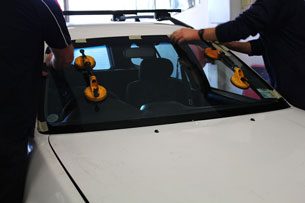
ADAS stands for advanced driver assistance systems. They range from simple warnings to systems that steer and brake. Many of them depend on a forward-facing camera mounted at the top of the windscreen, behind the rear-view mirror, and some also use radar sensors in the front bumper or grille.
Since July 2024, EU General Safety Regulation (EU) 2019/2144 has required new cars registered in the EU, including Ireland, to be fitted with a range of these systems, such as intelligent speed assistance and emergency lane keeping. The upshot is that camera-equipped windscreens are now normal rather than a premium extra, and calibration has become a routine part of windscreen replacement.
Which systems use the windscreen camera?
- Lane departure warning and lane keeping assist
- Autonomous emergency braking (often combined with radar)
- Traffic sign recognition and intelligent speed assistance
- Automatic high beam
- Adaptive cruise control on some models
The owner's manual or the original specification sheet for the car usually lists which systems are fitted. If you see a camera housing behind the mirror on the outside of the glass, the car almost certainly has at least one of them.
Why a new windscreen affects the camera
The camera is fixed to a bracket bonded to the glass. When the screen is replaced, the camera goes onto a new bracket on a new piece of glass. Tiny differences in the position of that bracket, the angle at which the screen sits in the frame, or the optical properties of the glass itself change where the camera is pointing. An error of a fraction of a degree might sound trivial, but projected down the road it can put the camera's idea of the lane markings or the car in front noticeably out.
That is why most vehicle manufacturers specify a calibration after a windscreen replacement, and often after other work such as wheel alignment or suspension repairs.
Static and dynamic calibration
| Static calibration | Dynamic calibration | |
|---|---|---|
| Where | In a workshop | On the road |
| How | The car is set up on a level floor in front of a target board at precise distances, and a diagnostic tool runs the calibration routine | A diagnostic tool puts the camera into calibration mode and the car is driven at set speeds on well-marked roads until the camera completes its learning |
| Needs | Space, a level floor, good lighting, manufacturer-specific targets | Clear lane markings, reasonable weather, the right speeds for long enough |
Some cars need static, some dynamic and some both. The manufacturer decides, not the fitter. Dynamic calibration in the North West can be slowed by the roads themselves: faded or missing lane markings on rural roads and heavy rain can stop a dynamic calibration from completing, which is one reason some fitters prefer a workshop setting.
What to ask before a windscreen is replaced
- Does my car need calibration after a new screen? A fitter can check from the registration or chassis number.
- Who will carry it out, and where? Some fitters calibrate on site, others send the car to a workshop or a dealer.
- Will the glass be the correct specification? The camera area of the glass must match the original, including any special coatings and the bracket.
- Will I get a calibration report? A printout or digital record shows the calibration was completed successfully. Keep it with the car's paperwork.
Signs a camera is not calibrated correctly
- A warning light or message about lane assist, emergency braking or the camera after the screen is replaced.
- Lane keeping that pulls the car towards one side, or warnings when you are clearly in lane.
- Traffic sign recognition reading signs late or not at all.
- False braking alerts, or none when you would expect them.
Not every miscalibration shows a warning light, so it is worth driving carefully and paying attention to how the systems behave for the first few days after a new screen. If anything seems wrong, go back to the fitter.
Does insurance cover calibration?
Where your policy covers windscreen replacement, calibration that the manufacturer requires is normally treated as part of the job. It is still worth confirming when you make the claim, because it affects which repairer can do the work and how long it takes. See windscreen cover in Ireland for the questions to ask.
Calibration and chip repairs
A chip repair does not normally require calibration, because the glass and the camera bracket stay where they are. The exception is damage in front of the camera itself, which can affect what the camera sees even after a repair. Many repairers will not repair damage in that area and will recommend a replacement.
Frequently asked questions
Does my car need calibration after a windscreen replacement?
If the car has a forward-facing camera behind the windscreen for systems such as lane keeping, emergency braking or sign recognition, the manufacturer usually requires the camera to be recalibrated after the screen is replaced.
What is the difference between static and dynamic calibration?
Static calibration is done in a workshop using target boards at set distances. Dynamic calibration is done by driving the car on well-marked roads while a diagnostic tool lets the camera relearn its position. The manufacturer specifies which method is needed.
How do I know calibration was done?
Ask for the calibration report or printout from the diagnostic equipment. Warning lights should also have cleared and the systems should behave normally.
Does a windscreen chip repair need calibration?
Normally not, because the glass and camera bracket are not moved. Damage directly in front of the camera is usually treated as needing a replacement instead.